

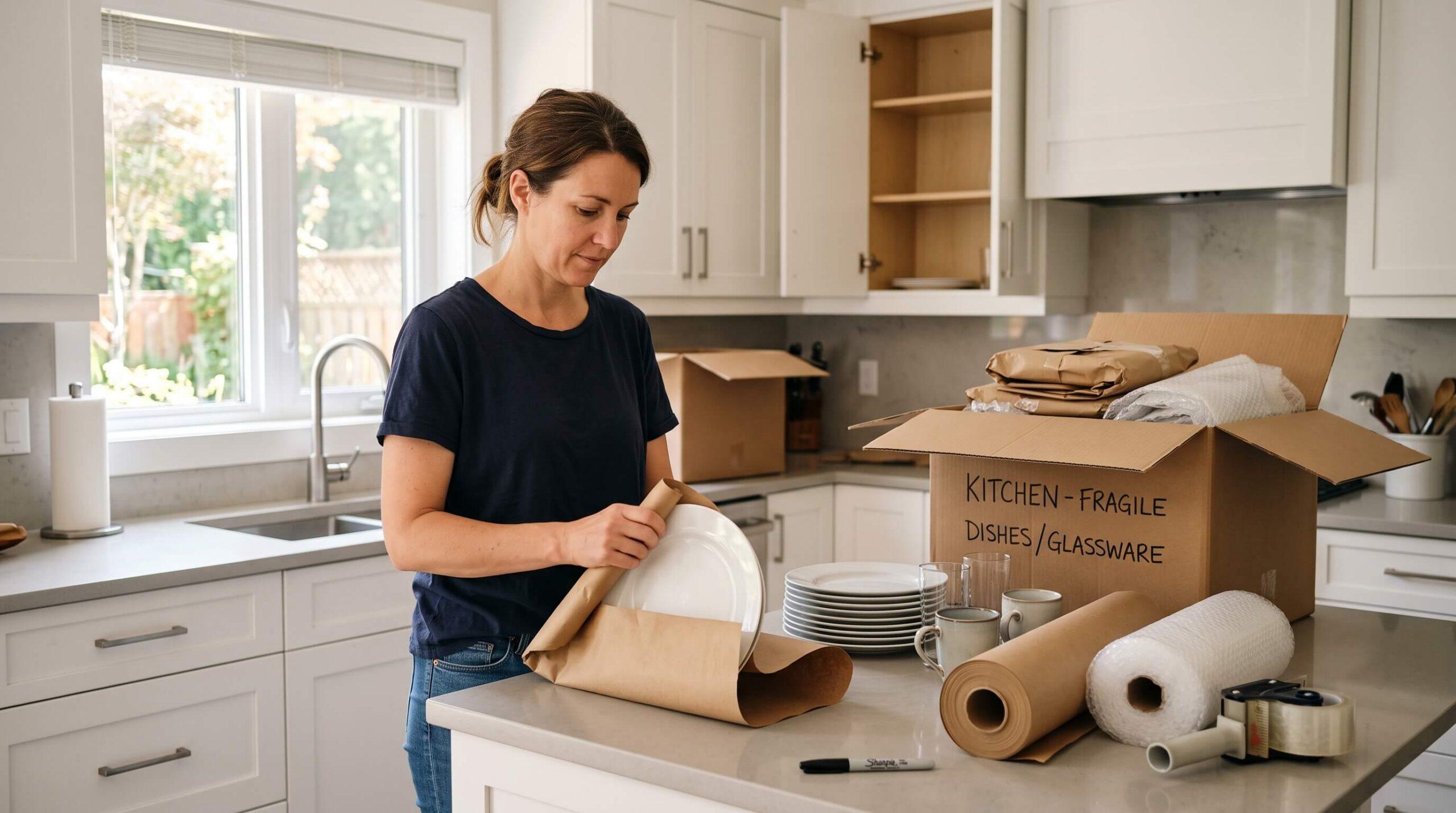
If you’ve ever moved before, you already know: the kitchen is the hardest room in the house. Knowing how to pack a kitchen for moving — and doing it in the right order — can save you hours of stress and prevent a lot of broken dishes. Whether you’re moving across Arnprior or relocating to Ottawa, this room-by-room guide will walk you through every drawer, cabinet, and appliance.
Why the Kitchen Takes the Most Time (and Planning)
The kitchen has more categories of items than any other room: fragile glassware, heavy appliances, sharp knives, oddly shaped gadgets, and a pantry full of jars that can leak or shatter. Most people underestimate how long it takes to pack properly — and then scramble in the final days.
Start packing your kitchen at least a week before moving day. Begin with the things you use least, and save the essentials for last.
What You’ll Need Before You Start
Gather your packing supplies before you open a single cabinet:
- Small, medium, and large moving boxes
- Packing paper (not newspaper — the ink transfers)
- Bubble wrap for fragile items
- Packing tape and a dispenser
- Permanent marker for labelling
- Zip-lock bags for screws, cords, and small parts
One tip from the team at Ardie’s Movers: label every box with both the contents and which side is up. It sounds obvious, but it makes a real difference when boxes are stacked in the truck.
Step 1: Declutter First
Before you pack a single thing, take stock of what’s actually worth moving. Open your cabinets with fresh eyes:
- Expired pantry items? Toss them.
- Duplicate gadgets you haven’t used in years? Donate or sell.
- Mismatched containers with no lids? Recycle them.
Moving is the perfect opportunity to reset your kitchen. The less you bring, the less you pack — and the less you unpack on the other end.
Step 2: Pack the Pantry
Start with dry goods, canned items, and anything shelf-stable. Here’s how to approach it:
Canned goods are heavy — pack them in small boxes to keep the weight manageable. Movers and your back will thank you.
Dry goods like pasta, rice, and cereal can go in medium boxes, but seal open bags with tape or transfer them to zip-lock bags to prevent spills.
Jars and bottles (oils, vinegars, condiments) are best packed upright with packing paper stuffed around them. Consider leaving perishables behind or using them up in the final week — they’re rarely worth the effort of moving.
Step 3: Wrap and Box Your Dishes
Dishes are where most people experience moving day heartbreak. The key is proper wrapping and smart stacking.
Plates should be wrapped individually in packing paper and packed on their edge — not flat. Plates stacked flat are more prone to cracking. Fill any gaps with crumpled paper.
Bowls can be nested in sets of two or three, with paper between each one, then wrapped as a bundle.
Glasses and mugs each get their own paper wrap. Tuck paper inside the glass first, then wrap the outside. Pack them upright in a box with dividers if possible — cell divider boxes are ideal for glassware.
Clearly mark these boxes FRAGILE and THIS SIDE UP. Don’t overpack — a box that’s too heavy is more likely to be dropped.
Step 4: Pack Pots, Pans, and Bakeware
Good news: these are the least stressful items to pack.
- Nest pots inside each other with a layer of packing paper or a dish towel between them to prevent scratching.
- Pack lids separately — they’re awkward shapes that don’t nest well and can crack if forced.
- Baking sheets and cutting boards can go in a flat box or stood vertically along the side of a box.
- Non-stick pans deserve a little extra care; wrap them individually to protect the coating.
Use towels, cloth napkins, and oven mitts as extra padding. They need to be packed anyway — might as well put them to work.
How to Pack a Kitchen for Moving: Appliances
Appliances are bulky, awkward, and often surprisingly fragile. Here’s how to handle the most common ones:
Coffee maker / kettle / toaster: Wrap in bubble wrap or packing paper. If you kept the original boxes, use them — manufacturer packaging is designed for the job. If not, pack them snugly in a medium box with padding around all sides.
Blender: Remove the blade assembly (wrap it separately — it’s sharp) and pack the jar and base separately with padding.
Stand mixer or food processor: These are heavy. Use a small box with plenty of cushioning, and pack any attachments in a labelled zip-lock bag taped to the top.
Microwave and small countertop appliances: Bubble wrap the outside, pack upright, and mark the box heavy.
Refrigerator and stove: Leave these to the movers. Large appliances require proper disconnection, securing of parts, and safe transport — it’s not a one-person job.
Step 5: Pack the Odds and Ends
Every kitchen has a junk drawer. Here’s how to tackle the rest:
Utensils: Bundle silverware sets in rubber bands, wrap sharp knives individually in several layers of paper (never loose in a box), and toss spatulas and wooden spoons into a tall kitchen pot.
Small appliance cords: Coil and secure with a twist tie, label them, and drop them in a zip-lock bag. Tape the bag to the appliance or pack it right beside it in the same box.
Dish rack, colander, strainer: Nest smaller items inside larger ones where possible, and pad with paper.
Step 6: Pack the Essentials Box Last
Don’t pack everything into the moving truck. Set aside a small box or bag with what you’ll need in the first 24 hours at your new place:
- Coffee maker or kettle
- A mug and a couple of plates
- Basic utensils (fork, knife, spoon)
- Dish soap and a sponge
- Paper towels
- A few snacks or easy-to-prepare foods
This “first night” box goes in your car — not the truck — so you have it immediately when you arrive.
A Word on Moving Day Itself
Even the most carefully packed kitchen can run into trouble on moving day if boxes aren’t loaded correctly. Make sure your fragile boxes are loaded last (so they come off first) and never stacked under heavy items.
The team at Ardie’s Movers has handled countless kitchen moves across Ottawa Valley and Renfrew County — they know how to load a truck so your dishes actually arrive in one piece. If you’re not confident in your packing, a professional moving team can also handle the packing for you.
Ready to Make Moving Day Easier?
Packing a kitchen properly takes time, but it’s absolutely worth the effort. Start early, pack smart, and don’t forget that essentials box.
When you’re ready to book your move, contact Ardie’s Movers for a free quote. They serve Arnprior, Renfrew County, and the greater Ottawa Valley — and they’ll treat your kitchen gear like it’s their own.
Get a free estimate
Call: 343-353-9900
Serving Arnprior, Ottawa Valley & Renfrew County